Wednesday, February 4, 2015

The Difference Between A Home’s Cost vs. Price

The Difference Between A Home’s Cost vs. Price

The Difference Between A Home’s Cost vs. Price | Simplifying The Market
As a seller, you will be most concerned about ‘short term price’ – where home values are headed over the next six months. As either a first time or repeat buyer, you must not be concerned only about price but also about the ‘long term cost’ of the home.

Let us explain.

There are many factors that influence the ‘cost’ of a home. Two of the major ones are the home’s appreciation over time, and the interest rate at which a buyer can borrow the funds necessary to purchase their home. The rate at which these two factors can change is often referred to as “The Cost of Waiting”.

What will happen in 2015?

nationwide panel of over one hundred economists, real estate experts and investment & market strategists project that home values will appreciate by almost 4% by the end of 2015.
Additionally, Freddie Mac’s most recent Economic Commentary & Projections Table predicts that the 30-year fixed mortgage rate will appreciate to 4.5% by the end of 2015.

What Does This Mean to a Buyer?

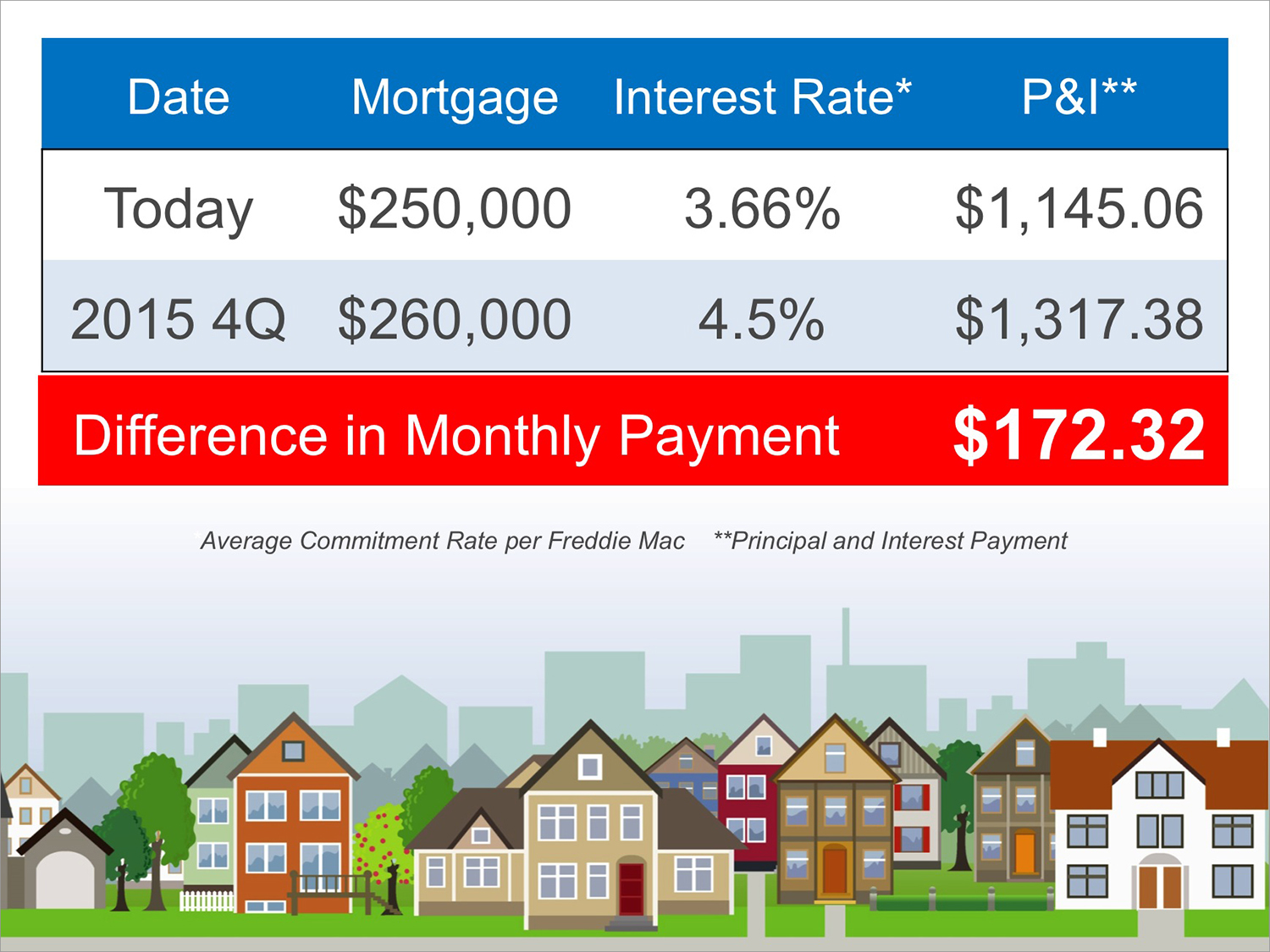
Here is a simple demonstration of what impact these projected changes would have on the mortgage payment of a home selling for approximately $250,000 today:
Cost of Waiting | Simplifying The Market

Tuesday, February 3, 2015

5 Reasons You Shouldn’t For Sale By Owner

5 Reasons You Shouldn’t For Sale By Owner

5 Reasons You Shouldn't For Sale By Owner | Simplifying The Market
Some homeowners consider trying to sell their home on their own, known in the industry as a For Sale by Owner (FSBO). There are several reasons this might not be a good idea for the vast majority of sellers.
Here are five reasons:

1. There Are Too Many People to Negotiate With

Here is a list of some of the people with whom you must be prepared to negotiate if you decide to For Sale By Owner:
  • The buyer who wants the best deal possible
  • The buyer’s agent who solely represents the best interest of the buyer
  • The buyer’s attorney (in some parts of the country)
  • The home inspection companies which work for the buyer and will almost always find some problems with the house.
  • The appraiser if there is a question of value

2. Exposure to Prospective Purchasers

Recent studies have shown that 88% of buyers search online for a home. That is in comparison to only 21% looking at print newspaper ads. Most real estate agents have an internet strategy to promote the sale of your home. Do you?

3. Results Come from the Internet

Where do buyers find the home they actually purchased?
  • 43% on the internet
  • 9% from a yard sign
  • 1% from newspaper
The days of selling your house by just putting up a sign and putting it in the paper are long gone. Having a strong internet strategy is crucial.

4. FSBOing has Become More and More Difficult

The paperwork involved in selling and buying a home has increased dramatically as industry disclosures and regulations have become mandatory. This is one of the reasons that the percentage of people FSBOing has dropped from 19% to 9% over the last 20+ years.

5. You Net More Money when Using an Agent

Many homeowners believe that they will save the real estate commission by selling on their own. Realize that the main reason buyers look at FSBOs is because they also believe they can save the real estate agent’s commission. The seller and buyer can’t both save the commission.
Studies have shown that the typical house sold by the homeowner sells for $208,000 while the typical house sold by an agent sells for $235,000. This doesn’t mean that an agent can get $27,000 more for your home as studies have shown that people are more likely to FSBO in markets with lower price points. However, it does show that selling on your own might not make sense.

Bottom Line

Before you decide to take on the challenges of selling your house on your own, sit with a real estate professional in your marketplace and see what they have to offer.

Monday, February 2, 2015

No Matter What the Groundhog Says… You Should Sell Before Spring!

No Matter What the Groundhog Says… You Should Sell Before Spring!

No Matter What
Is spring closer than we think? Depending on which Groundhog you witnessed today, you may have less time than you think to get your home on the market before the busy spring season.
Many sellers feel that the spring is the best time to place their home on the market as buyer demand traditionally increases at that time of year. However, the next six weeks before spring hits also have their own advantages.

Here are five reasons to sell now.

1. Demand is Strong

Foot traffic refers to the number of people out actually physically looking at homes right now. The latest foot traffic numbers show that there are currently more prospective purchasers looking at homes than at any other time in the last 12 months, which includes last spring’s buyers’ market. These buyers are ready, willing and able to purchase… and are in the market right now!
Take advantage of the buyer activity currently in the market.

2. There Is Less Competition Now

Housing supply just dropped to 4.4 months, which is under the 6 months’ supply that is needed for a normal housing market. This means, in many areas, there are not enough homes for sale to satisfy the number of buyers in that market. This is good news for home prices. However, additional inventory is about to come to market.
There is a pent-up desire for many homeowners to move, as they were unable to sell over the last few years because of a negative equity situation. Homeowners are now seeing a return to positive equity as real estate values have increased over the last two years. Many of these homes will be coming to the market in the near future.
Also, new construction of single-family homes is again beginning to increase. A recent study by Harris Poll revealed that 41% of buyers would prefer to buy a new home while only 21% prefer an existing home (38% had no preference).
The choices buyers have will increase in the spring. Don’t wait until all this other inventory of homes comes to market before you sell.

3. The Process Will Be Quicker

One of the biggest challenges of the housing market has been the length of time it takes from contract to closing. Banks are requiring more and more paperwork before approving a mortgage. There is less overall business done in the winter. Therefore, the process will be less onerous than it will be in the spring. Getting your house sold and closed before the spring delays begin will lend itself to a smoother transaction.

4. There Will Never Be a Better Time to Move-Up

If you are moving up to a larger, more expensive home, consider doing it now. Prices are projected to appreciate by over 23.5% from now to 2019. If you are moving to a higher priced home, it will wind-up costing you more in raw dollars (both in down payment and mortgage payment) if you wait. You can also lock-in your 30-year housing expense with an interest rate below 4% right now. Rates are projected to be a full point higher by the end of 2015.

5. It’s Time to Move On with Your Life

Look at the reason you decided to sell in the first place and determine whether it is worth waiting. Is money more important than being with family? Is money more important than your health? Is money more important than having the freedom to go on with your life the way you think you should?
Only you know the answers to the questions above. You have the power to take back control of the situation by putting your home on the market. Perhaps, the time has come for you and your family to move on and start living the life you desire.

That is what is truly important.

Thursday, January 29, 2015

13,808 Houses Sold Yesterday! Did Yours?

13,808 Houses Sold Yesterday! Did Yours?

13,808 Houses Sold Yesterday! Did Yours? | Simplifying The Market
There are some homeowners that have been waiting for months to get a price they hoped for when they originally listed their house for sale. The only thing they might want to consider is... If it hasn't sold yet, maybe it's not priced properly.

After all 13,808 houses sold yesterday, 13,808 will sell today and 13,808 will sell tomorrow.

13,808!

That is the average number of homes that sell each and every day in this country according to the National Association of Realtors’ (NAR) latest Existing Home Sales Report. NAR reported that sales are at an annual rate of 5.04 million. Divide that number by 365 (days in a year) and we can see that, on average, over 13,800 homes sell every day.
The report from NAR also revealed that there is currently only a 4.4 months supply of inventory available for sale, (6 months inventory is considered ‘historically normal’).
That means less competition for buyers who are out in the market now, but more houses will hit the market soon with spring right around the corner.

Bottom Line

We realize that you want to get the fair market value for your home. However, if it hasn't sold in today's active real estate market, perhaps you should reconsider your current asking price.

Tuesday, January 27, 2015

Why Have Interest Rates Dropped?

Why Have Interest Rates Dropped?

Why Have Interest Rates Dropped? | Simplifying The Market
The headlines agree mortgage interest rates have dropped substantially below initial projections. Many who are considering purchasing a home, or moving up to their dream home, might think that they should wait to buy, because rates may continue to fall.
A recent article on the Economists’ Outlook blog by the National Association of REALTORS® (NAR) provides insight into one major factor in the decline in interest rates, the crude oil price.
“As of January 5, 2015, the U.S. Energy Information Administration (EIA) reported that the price of regular gasoline was $2.20/gallon, the lowest since gas prices peaked to about $ 4/gallon in May 2011.”
You may have noticed that filling your gas tank has become substantially less expensive in recent months. A welcome change from the close to $5 a gallon that many Americans were paying this time last year. The average US household is projected to save around $550 in 2015.

So what does that have to do with Interest Rates?

NAR explains the correlation like this:
“Lower oil prices mean lower inflation rate, which pushes down mortgage rates.”
Based on Freddie Mac’s weekly mortgage survey as of January 22, 2015, the 30-year fixed rate averaged 3.63% and the 15-year fixed rate averaged 2.93%.
“The decline in oil prices is generally positive to households by way of the gas savings and lower mortgage payments. That savings will boost consumer spending in other areas. But there may be some layoffs in oil-producing states.”

How long will rates stay low?

No one really knows how long oil prices will continue to support low mortgage rates. In a New York Times article, the author points to the fact that “adding hundreds of billions of dollars to consumer spending” could start to have a “counter effect” on rates as the economy continues to strengthen.
“If firms start hiring again, and wages increase — that’s when the level of all interest rates in the U.S. would increase.” 

Don’t wait too long

The low interest rates we are currently experiencing are not going to stay around forever. The current projections from Freddie Mac, Fannie Mae, NAR and the Mortgage Bankers Association all agree that interest rates will increase to between 4.3-5.4% by the end of 2015.

Bottom Line

NAR reports: “At the median home price of $205,300, a 0.75 percentage point drop in mortgage rates will yield savings of about $1,000 annually.”
If you are in a position to buy a home make sure that you meet with a local real estate professional with their finger on the pulse of what’s going on in the market. Don’t let a delay in purchasing impact your family’s financial future.

Thursday, January 22, 2015

Thinking Of Selling? Now May Be The Time

Thinking Of Selling? Now May Be The Time

Thinking Of Selling? Now May Be The Time | Simplifying The Market
It is common knowledge that a large number of homes sell during the spring buying season. For that reason, many homeowners hold off putting their home on the market until then. The question is whether or not that will be a good strategy this year.
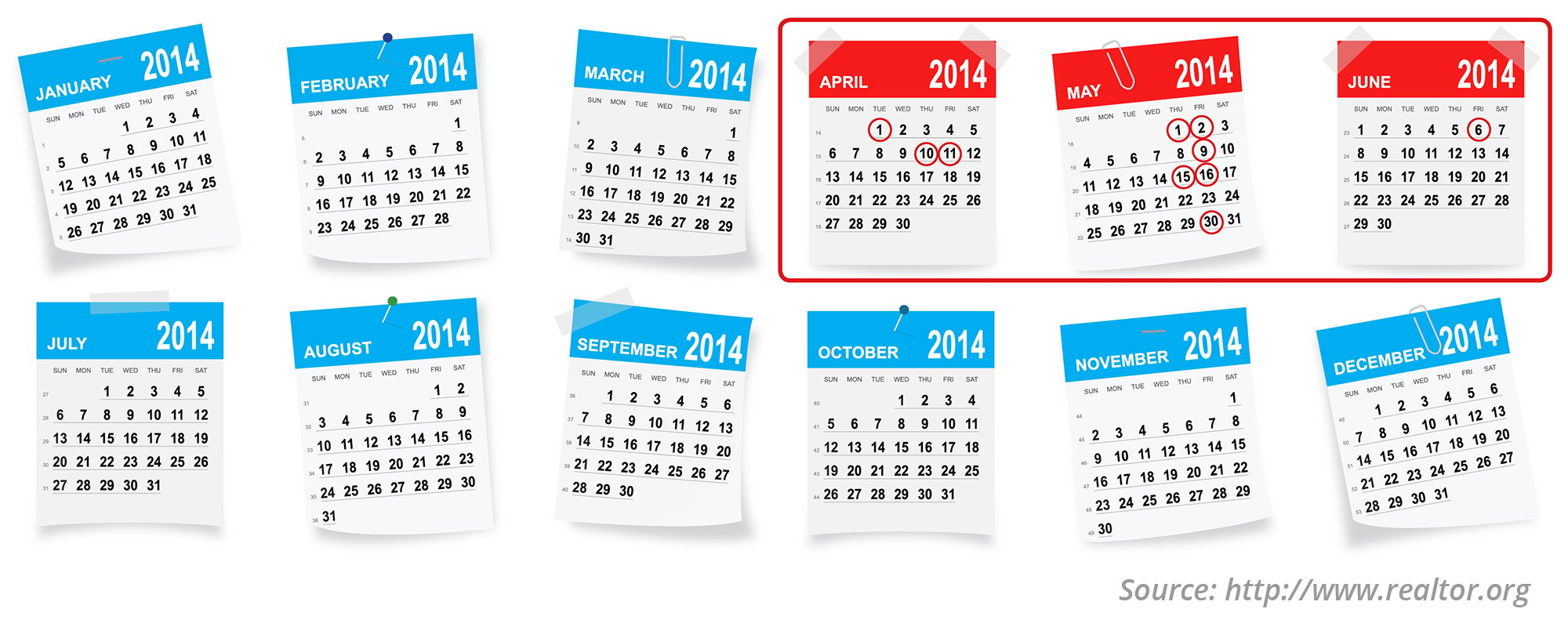
The other listings that do come out in the spring will represent increased competition to any seller. Do a greater number of homes actually come to the market in the spring compared to the rest of the year? The National Association of Realtors (NAR) recently revealed which months and days of the year most people list their home. Here is a graphic showing the results:
Top 10 Listing Dates of 2014 | Simplifying The Market
The circles represent the ten most popular listing dates in 2014. We can see that all ten days are in the second quarter of the year. The months in red represent which months most people put their home on the market. Again, the three months in the second quarter are most active for listings. Last year, the number of homes available for sale in January was 1,880,000.

That number spiked to 2,350,000 by July!

What does this mean to you?

With the job situation improving and mortgage interest rates projected to rise later in the year, buyers are not waiting until the spring. They are out looking for a home right now. If you are looking to sell this year, waiting until the spring to list your home means you are putting your house on the market at a time you will have the greatest competition for your buyer. It may make sense to beat that rush of housing inventory to the market and list your home today.

Tuesday, January 20, 2015

3 QUESTIONS TO ASK BEFORE BUYING A HOME

3 QUESTIONS TO ASK BEFORE BUYING A HOME

3 Questions to Ask Before Buying a Home | Simplifying The Market
If you are thinking about purchasing a home right now, you are surely getting a lot of advice. Though your friends and family have your best interests at heart, they may not be fully aware of your needs and what is currently happening in real estate. Let’s look at whether or not now is actually a good time for you to buy a home.
There are three questions you should ask before purchasing in today’s market:

1. Why am I buying a home in the first place?

This truly is the most important question to answer. Forget the finances for a minute. Why did you even begin to consider purchasing a home? For most, the reason has nothing to do with finances. A study by the Joint Center for Housing Studies at Harvard University reveals that the four major reasons people buy a home have nothing to do with money:
  • A good place to raise children and for them to get a good education
  • A place where you and your family feel safe
  • More space for you and your family
  • Control of the space
What non-financial benefits will you and your family derive from owning a home? The answer to that question should be the biggest reason you decide to purchase or not.

2. Where are home values headed?

When looking at future housing values, Home Price Expectation Survey provides a fair assessment. Every quarter, Pulsenomics surveys a nationwide panel of over one hundred economists, real estate experts and investment & market strategists about where prices are headed over the next five years. They then average the projections of all 100+ experts into a single number.
Here is what the experts projected in the latest survey:
  • Home values will appreciate by 4% in 2015.
  • The cumulative appreciation will be 23.5% by 2019.
  • Even the experts making up the most bearish quartile of the survey still are projecting a cumulative appreciation of over 15.1% by 2019.

3. Where are mortgage interest rates headed?

A buyer must be concerned about more than just prices. The ‘long term cost’ of a home can be dramatically impacted by an increase in mortgage rates.
The Mortgage Bankers Association (MBA), the National Association of RealtorsFannie Mae and Freddie Mac have all projected that mortgage interest rates will increase by approximately one full percentage over the next twelve months.

Bottom Line

Only you and your family can know for certain the right time to purchase a home. Answering these questions will help you make that decision.

Monday, January 19, 2015

Don’t Wait! Move Up To The House You Always Wanted

Don’t Wait! Move Up To The House You Always Wanted

Don’t Wait! Move Up To The House You Always Wanted | Simplifying The Market
Now that the housing market has stabilized, more and more homeowners are considering moving up to the home they have always dreamed of. In most areas, prices are still below those of a few years ago. Also, interest rates are still near 4%.
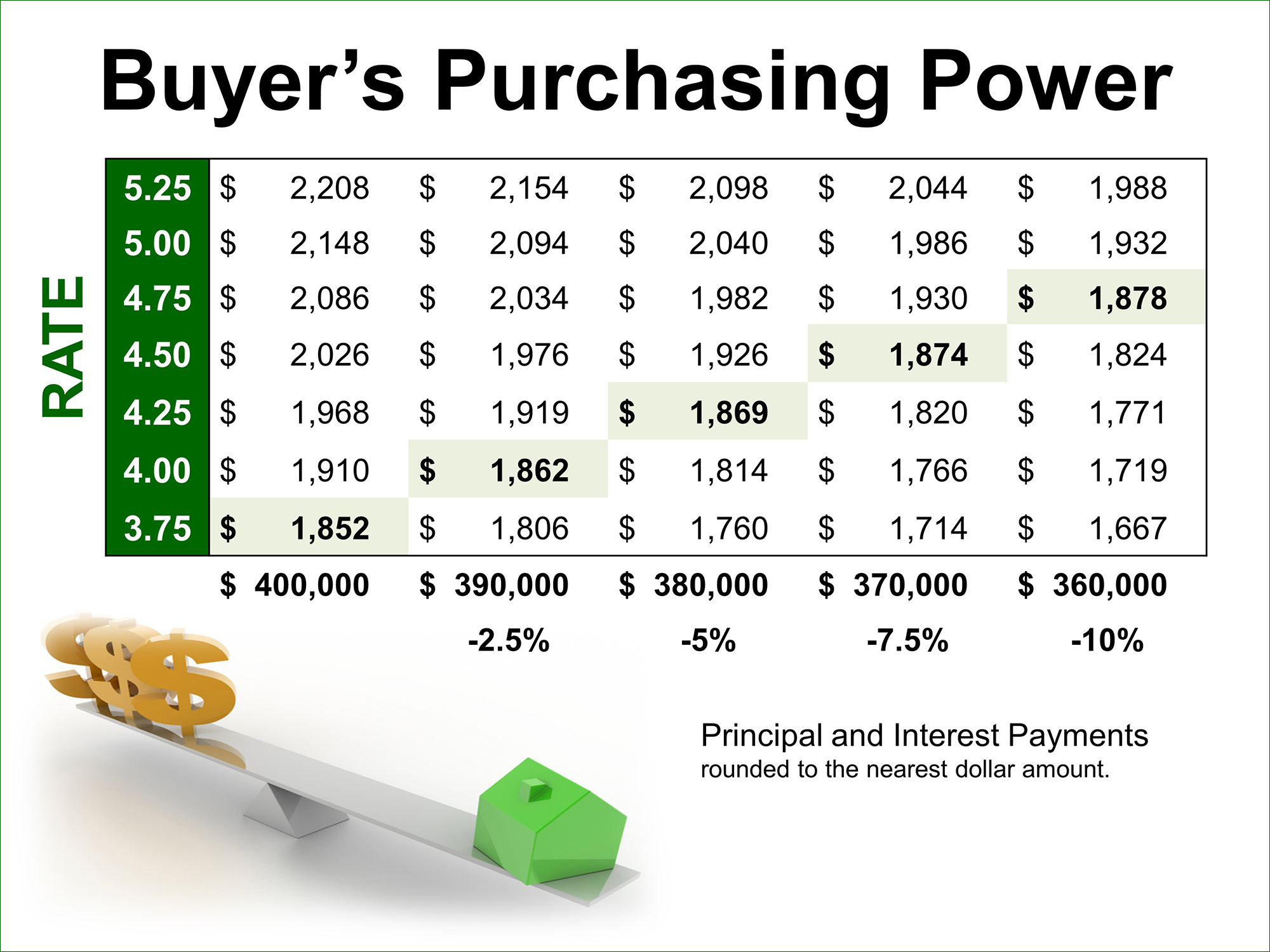
However, sellers should realize that waiting to make the move while mortgage rates are increasing probably doesn’t make sense. As rates increase, the price of the house you can buy will decrease. Here is a chart detailing this point:
Buyers Purchasing Power | Simplifying The Market

Monday, January 12, 2015

Did It Make Sense to Wait?

Did It Make Sense to Wait?

Did It Make Sense to Wait? | Simplifying The Market
There are many people out there who debated purchasing a home over the course of the last year, but ultimately did not. Whatever their reasons were for delaying, let’s look at whether the decision to wait to buy made sense.

What happened in 2014?

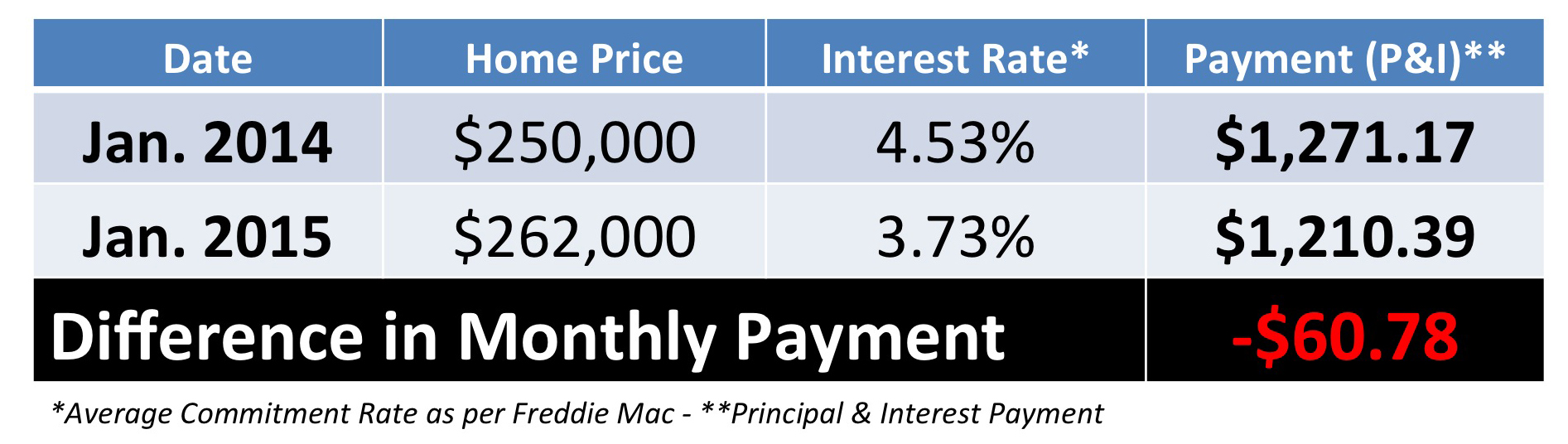
The 30 year fixed rate on January 2, 2014 was 4.53% as reported by Freddie Mac. Looking at the chart below, your monthly mortgage payment with principal and interest for a $250,000 home would have been $1,271.17.
Even though interest rates have dropped below 4% and ended 2014 at 3.87%, home prices appreciated by 4.8 percent over the same time according to the Home Price Expectation Survey.
So that same home appreciated by $12,000 and now costs $262,000. The most recent report by Freddie Mac reports the average 30-year fixed rate is currently 3.73%.
Did It Make Sense To Wait? | Simplifying The Market
Many may say, “See waiting a year made total sense, I’m saving $60 a month.” And they’d be right, over the course of the year they saved $729.36.
But what they haven’t realized, is that as the price of the home they purchased went up by $12,000, even if they just put a down payment of 5%, they had to come up with an additional $600 at the start of the process. So really they’ve only saved $129.36 in a year.
Is a savings of $11 a month really worth holding off on pursuing a home to call your own after you weigh all the benefits that come along with that?
  • Building equity you can borrow against in the future
  • Having a safe, comfortable environment that fits your family’s needs
  • Having control over your space
  • Tax benefits
  • And so many more…

Bottom Line

The experts are predicting that homes will appreciate by another 4% and interest rates will increase by a full percentage point by the end of 2015. If you are in a position to be able to buy a home now before these predictions become reality, contact a local real estate professional and start the process.

Thursday, January 8, 2015

A Stunning $441 Billion Paid in Rent

A Stunning $441 Billion Paid in Rent


A Stunning $441 Billion Paid in Rent | Simplifying The Market
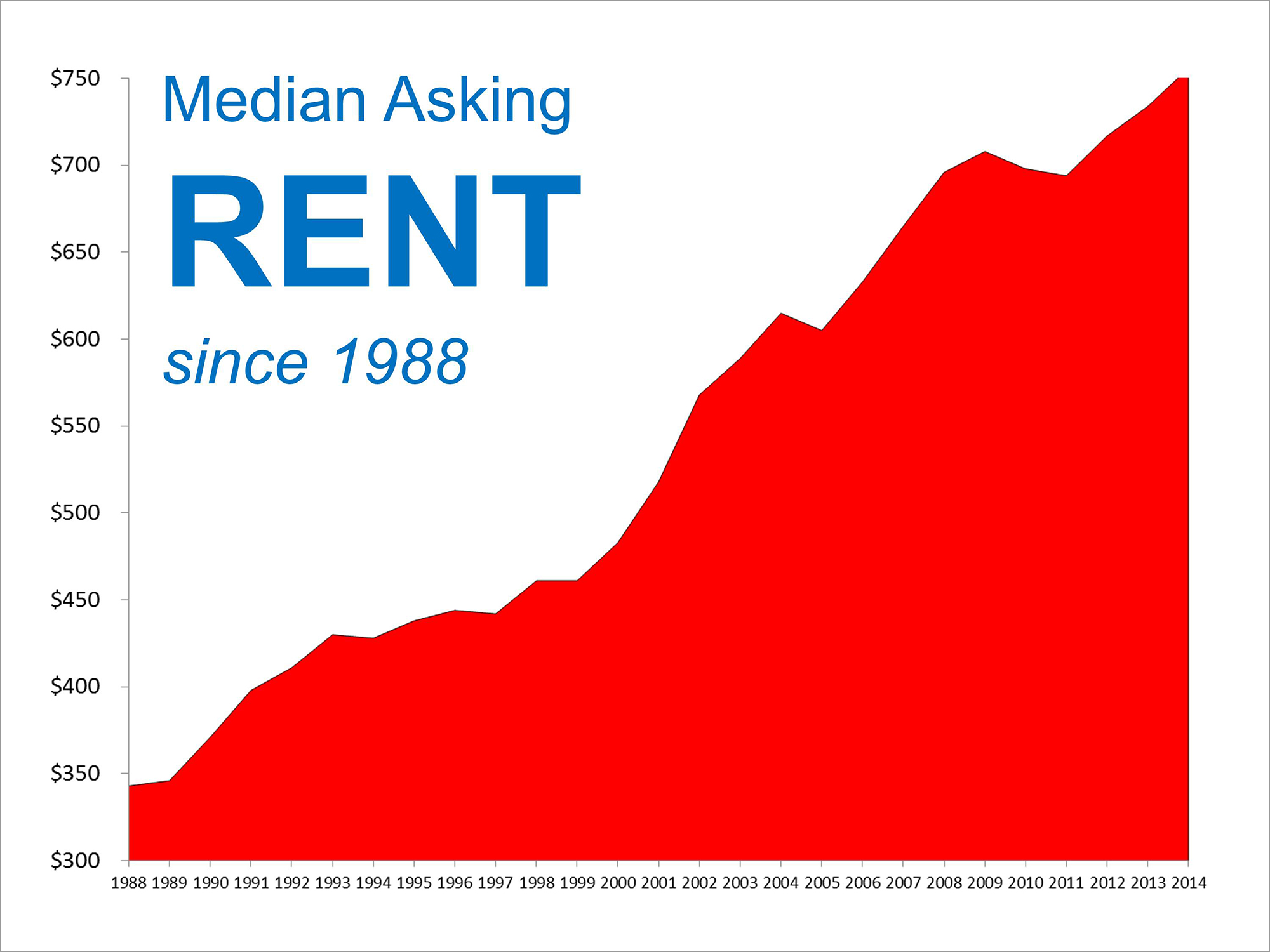
A recently released study revealed that a whopping $441 Billion was spent on rents in the U.S. in 2014. This represents an increase of over $20 Billion from the year before. As shown on the chart below, rents have increased consistently over the last 20+ years.
Median Rents Since 1988 | Simplifying The Market
However, the recent increases have been astounding.

Why such a jump? 

Many Millennials have postponed the purchase of their first home while waiting for the economy to recover. This has increased demand and dramatically lowered vacancy rates. In a recent article on the MarketWatch, economics reporter Ruth Mantell explains:
“Landlords have ramped up rents by the fastest pace in six years, with national vacancy rates the lowest in two decades.”
Zillow Chief Economist Stan Humphries let us know that increases will continue:
“Another increase in total rent paid similar to that seen this year isn't out of the question. In fact, it's probable."

Wednesday, January 7, 2015

4 REASONS TO BUY BEFORE SPRING

4 REASONS TO BUY BEFORE SPRING

4 Reasons to Buy Before Spring | Simplifying The Market
The holiday season is behind us, time to focus on what exciting new experiences 2015 can bring! If you are planning on becoming a homeowner, or moving up to the home of your dreams in 2015, here are four great reasons to consider buying a home now, instead of waiting until spring.

1. Prices Will Continue to Rise

The Home Price Expectation Survey polls a distinguished panel of over 100 economists, investment strategists, and housing market analysts. Their most recent report projects appreciation in home values over the next five years to be between 15.1% (most pessimistic) and 32.8% (most optimistic).
The bottom in home prices has come and gone. Home values will continue to appreciate for years. Waiting no longer makes sense. 

2. Mortgage Interest Rates Are Projected to Increase

Although Freddie Mac’s Primary Mortgage Market Survey shows that interest rates for a 30-year mortgage have softened recently, most experts predict that they will begin to rise over the next 12 months. The Mortgage Bankers Association, Fannie Mae, Freddie Mac & the National Association of Realtors are in unison projecting that rates will be up almost a full percentage point by the end of 2015.
An increase in rates will impact YOUR monthly mortgage payment. Your housing expense will be more a year from now if a mortgage is necessary to purchase your next home.

3. Either Way You are Paying a Mortgage

As a paper from the Joint Center for Housing Studies at Harvard University explains:
“Households must consume housing whether they own or rent. Not even accounting for more favorable tax treatment of owning, homeowners pay debt service to pay down their own principal while households that rent pay down the principal of a landlord plus a rate of return. That’s yet another reason owning often does—as Americans intuit—end up making more financial sense than renting.”

4. It’s Time to Move On with Your Life

The ‘cost’ of a home is determined by two major components: the price of the home and the current mortgage rate. It appears that both are on the rise.
But, what if they weren’t? Would you wait?
Look at the actual reason you are buying and decide whether it is worth waiting. Whether you want to have a great place for your children to grow up, you want your family to be safer or you just want to have control over renovations, maybe it is time to buy.
If the right thing for you and your family is to purchase a home this year, buying sooner rather than later could lead to substantial savings.